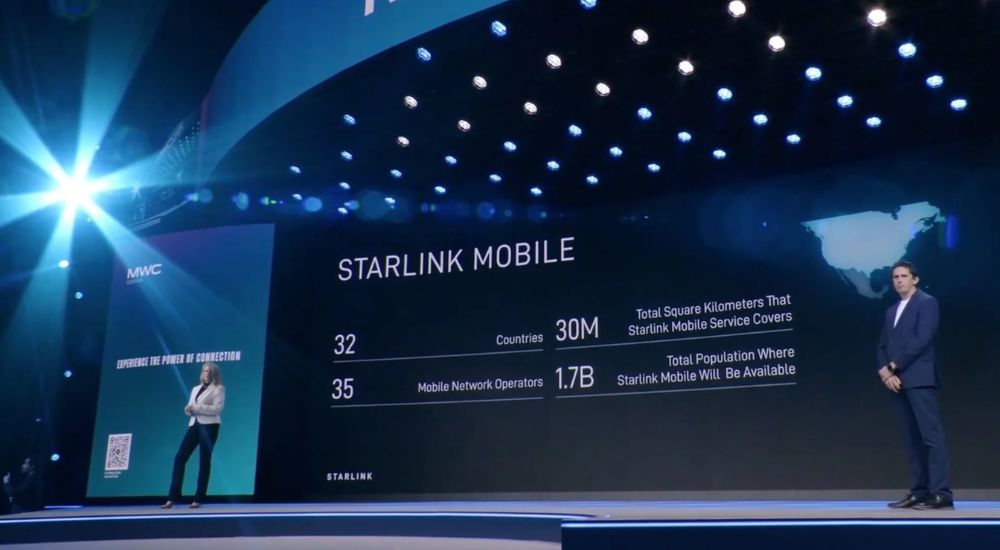

SpaceX has announced the Starlink Mobile system at the MWC 2026, which will be out in 2027. It will work to enhance the terrestrial networks and won’t compete with other players.
The US-based satellite connectivity provider branded its Direct to Cell service as Starlink Mobile. It filed an application to trademark in 2025. The company has set a target of serving hundreds of millions of devices with the Starlink service on phones. At the moment, it’s serving 16 million users.
“The second-generation Starlink Mobile system will be epic—broadband connectivity to hundreds of millions of phones globally,” said Michael Nicolls, SpaceX’s VP for Satellite Engineering.
During his keynote speech at MWC, Nicolls said that its first-generation system works with 650 satellites connecting over 16 million users and has 10 million active users through T-Mobile in the US (T-Satellite), Rogers in Canada (Rogers Satellite), and KDDI in Japan.
“We expect that number to exceed 25 million by the end of 2026,” Nicolls later added. Using orbiting satellites, instead of ground-based cell towers, also means that Starlink Mobile is the “largest 4G coverage by geographic area in the world,” enabling it to serve eligible users in cellular dead zones across the globe, he said.
“We’ll be able to launch more than 50 satellites on every [Starship] launch, and we’ll begin launching in mid-2027,” he added. “With Starship, we’ll be able to deploy the constellation very quickly. Our goal is to deploy a constellation capable of providing global and continuous coverage within six months. And that’s roughly 1,200 satellites.”
Starlink Mobile complements terrestrial service
Nicollis said that Starlink Mobile will help enhance ground networks when they need further capacity. “It’s where Starlink Mobile is a key component of a hybrid network that includes terrestrial and satellite capabilities. Satellite is complementary to terrestrial networks; it cannot provide the data density that terrestrial networks have. But it can augment terrestrial networks in places where terrestrial networks cannot reach. Or when terrestrial networks need additional capacity.”
The statement was delivered at MWC, an annual gathering of telecommunications providers, where SpaceX is likely seeking to secure additional partnerships for Starlink Mobile. The service was previously known as “Direct to Cell.” But on Monday, the company debuted the new Starlink Mobile name, along with a website for it. The rebrand might get a little confusing, since SpaceX’s partner carriers have also been promoting their own names for the service. In the US, for example, T-Mobile calls it T-Satellite. Canadian carrier Rogers simply calls it Rogers Satellite.
He said that the company aims for a peak speed of 150 Mbps per user. Version 1 of Starlink Mobile supports video calls, text messaging, and select apps. But the speed is limiting with users getting on average, a meager 4 Mbps.
“The second-generation satellite will have nearly 100 times the data density of a V1 satellite. Again, we accomplish this with a much larger phased array, which means a smaller spot beam on the ground. And as well as 16 times the number of beams per satellite and other advanced features,” he said.
To enhance its network capacity, it has reached a deal with Boost Mobile’s parent, EchoStar, to get additional spectrum, which will ensure better performance (higher speed) for Starlink Mobile.